
Tanaf, Senegal
We believe materiality and form-making would eventually contribute to a monumentality that portrays sacred buildings
praying center
religion, architecture
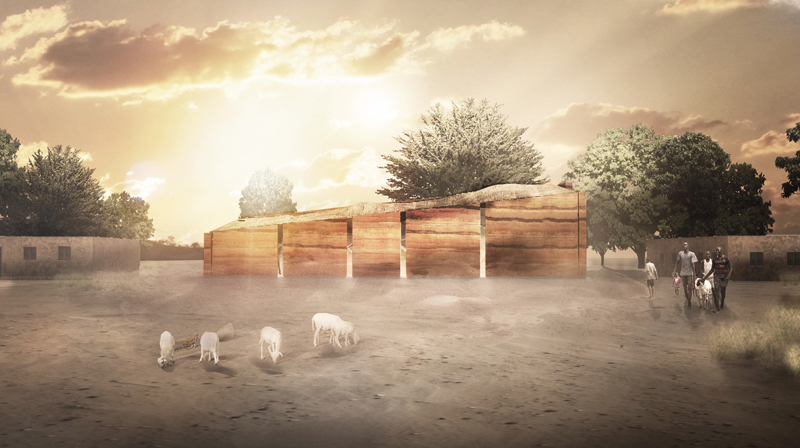
Our site locates in the rural part of the Casamance region in the far south of Senegal, bordering Guinea-Bissau, where drought and salt intrusion severely affected the environment. We faced the challenge of limited building materials, lacking experienced construction workers, and financial constraints. But challenges also mean chance. The locals have been utilizing the vernacular building for thousands of years. Locality and contextuality are the most celebrated qualities and characters found on buildings around the site and also constitute the fundamentals of the spirituality of sacred architecture for local people. The existing great mosque of Tanaf will be demolished. At this very strategic location, the new proposal will be a focal point for villagers, connecting streams from in and outside the village. By embedding and positioning the building volume, a gathering plaza is formed in front, welcoming worshippers and visitors coming from the main road. In the meantime, it also releases the blockage of the main road for traffic.
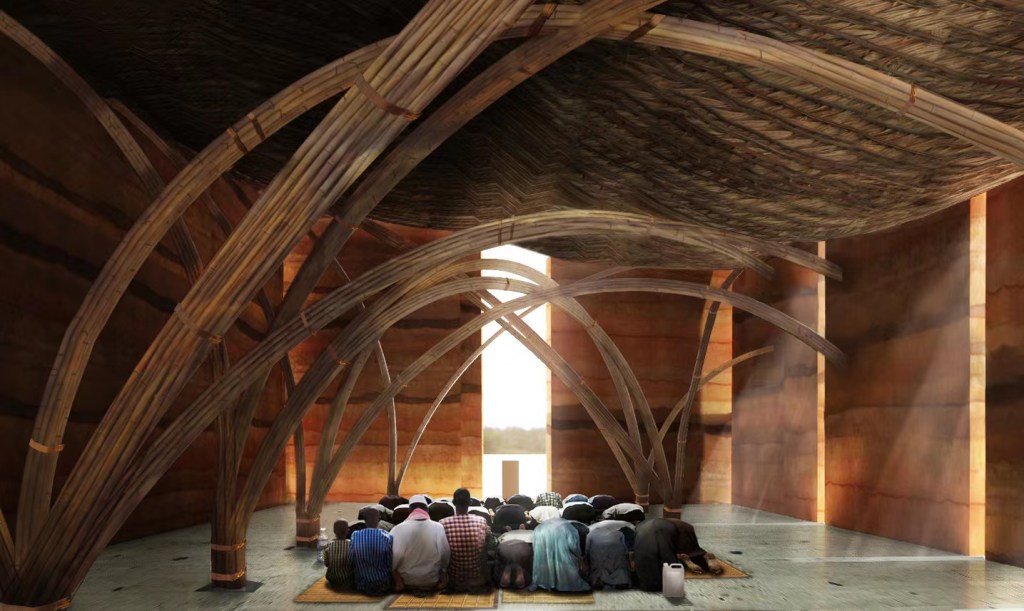
Our proposal features a monolith-like body with light bamboo column trusses and rammed earth wall as load-bearing elements, accommodated with a minimalist floor plan with an accentuation on natural light and horizontality. Its free floor plan and the meandering trusses activate movement and elevate spatial quality. The “slits” in the walls on one hand strengthened the identity of the building by moderately distinguishing itself from ordinary civic buildings in terms of approaches in making openings, on the other hand, inwardly, gently invited in natural lights for lighting up the prayer hall and most significantly, defining the orientation.
Inspired by vernacular architectures in West African countries, we aimed at composing with easily acquirable indigenous materials in and around the region. We believe materiality and form-making would eventually contribute to a monumentality that portrays sacred buildings.
In this proposal, the enclosure and divinity are framed within earthly walls, made of local laterite, clay, and sand. The proportion of ingredient composition varies each time when made on site, as well as the labor used when compacted, it in the end results in a colorful layering pattern resembling a section of time. Especially, laterite has a clay-like consistency granting it greater water-holding capacity than sandy soils and thus making it valuable for construction components. And because of its thermal nature, it can act as a building coolant. We choose bamboo particularly for the column-truss structure because it is such a versatile and durable material. We are hoping through this endeavor, bamboo as construction material, would be rediscovered and therefore utilized. In almost 20 African countries including Senegal, natural bamboo plantation resources are plenty. It is about time to raise awareness of bamboo’s value from many perspectives, for which the UN also sponsored foundations and networks in promoting this wonder plant, for instance, INBAR.
 TAKE U CHI+M